
This recipe was first published on 4 Nov 2015. Recipe Updated on 28 Oct 2021 with a new video
A couple of years ago my childhood friend Veda shared her recipe for the nankhatai, a lovely Indian sweet biscuit that is usually prepared during the festive season. In India we use the term ‘biscuit’ for cookies and these little melt-in-your-mouth wonders are pretty much like shortbread cookies but slightly differ in taste and texture owing to the use of ghee (clarified butter) instead of butter. During my growing up years the nankhatai was available at most bakeries in Mangalore and was prepared in homes especially during Deepavali and Christmas. Although the nankhatai is not a traditional item on the Kuswar (a Mangalorean collection of Christmas sweets & savouries) platter it is served in many homes along with other non traditional sweets such as coconut burfi and marzipan etc. While across India they are called as the ‘nankhatai’, in Mangalore they are also known as the Narayan Katar (in bakeries and such) and Nan Cuts (mostly by Catholics who make it during Christmas)
Ok, so now coming back to the nankhatai, when I made these a few days ago I was wondering why I sat on the recipe for two whole years before trying it out. Since Veda and I are chaddi-buddies who cannot start the day without chatting with each other on Whatsapp, sharing recipes on a daily basis is a natural occurrence, pretty much like the rising and setting of the sun.

When she showed me pictures of the nankhatais she made a couple of weeks ago I thought it was high time I tried making them. I was bowled over by the simplicity and taste of this marvellous invention of some genius mind. This was simply one of the best recipes that I’ve ever tried till date especially because nankhatais are so very easy to make! The only reason that I tried them thrice over a span of a few days was to master the technique of getting the cracks on top as this is how I remember eating nankhatais back home in Mangalore!

What I love about these nankhatais is that the addition of salt not only brings out the flavour but you actually get to taste the grains of salt that shine through the cookie. Every now and then you will get to taste some salt that balances the sweetness really well. The cookie, if made as per the instructions is meant to have a hollow in the centre and is pretty soft to the bite yet has a crunch of its own. Once it begins to crumble it melts into your mouth in a glorious way, you just can’t stop with one, I can bet!


These are such a festive treats that you can even gift them to your loved ones. Make them pretty by adding saffron to the ghee before kneading the dough – this will result in beautiful, pale yellow nankhatais that are aromatic too. Alternatively you may add food colours but I wanted them to be pure white devoid of any colours or flavourings.
I do hope that you make these and enjoy them too!! And yes if you do enjoy them, don’t forget to bless and say a little prayer for my sweet friend Veda Pai who has in turn blessed me with her friendship and my blog with some great recipes like Corn Rice, Bibbe Sagle, Laayi Pitte Undo, Coconut Red Chilli Chutney, Panchakajjaya, Phagila Podi & Easy Cheesy Macaroni.
So a big thank you Veda from the bottom of my heart – May God bless you always with health and happiness! Looking forward to many more ravishing, gorgeous & mind blowing recipes from you!

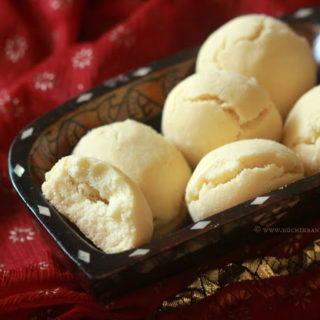
Nankhatai | Indian Shortbread Cookies
Nankhatais are lovely Indian sweet biscuit/shortbread cookies that are usually prepared during the festive season. They are round, dome shaped with a crack on top and hollow inside. Buttery, delicious and melt-in-the-mouth treats!
Print
Pin
Rate
Ingredients
- 150 grams approx 1-1/3 cups all purpose flour (maida) plus a tablespoon or two extra if required * see notes
- 100 grams 1/2 cup granulated sugar, powdered to a fine texture after measuring * see notes
- 100 grams 1/2 cup hot ghee (melted)
- 1/8 th teaspoon salt
- 1/2 teaspoon soda bi carb baking soda
- a large pinch of saffron strands optional
- a few drops of food colour if desired
- a pinch of cardamom optional
- slivers of almonds or pistachios optional
Instructions
- Place the melted ghee in a bowl (if you are using saffron or any food colour add it to the ghee) and add the sugar powder a little by little till it is well mixed.
- Mix the flour, baking soda and salt together and sift it part by part into the ghee and sugar mixture. Use a spoon to mix well. If you feel that the dough is spreading too much (paste like) then it could be because the ghee was too hot and the sugar has melted in it leading to excess moisture. If you wish you can add an extra 1-2 tablespoons of flour until you are able to get a kneading consistency.
- Lightly knead the dough till it is smooth, place it in clingfilm (plastic wrap) or cover the bowl with cling film. Keep aside for 4 hours for best results.
- After 4 hours, the dough ball may have hardened a bit (if you live in cooler climates). Gently knead it for a couple of minutes until it is soft and pliable.
- Preheat the oven to 170 degrees C. Line a large baking sheet/tray with parchment and keep it ready.
- Divide the dough into 12-16 equal portions (I usually get 16 equal portions) and roll each portion into a ball and gently flatten the sides only - let the shape remain more like a mound (dome) than flattening them into patties/cutlets. The dome shape helps create cracks on the surface when the heat tries to escape each cookie during the process of cooking. This is how traditional cookies look like but if you want them flatter and without cracks you can flatten them.
- Place each portion on the prepared tray and bake for 18-20 minutes or until just light golden in colour and the cracks appear. Do not overbake as they will brown fast.
- Remove the tray out of the oven and let the nankhatais cool on the tray for 10-12 minutes. Then gently transfer onto a wire rack to cool completely. Store in an airtight container.
Notes
1. I have tried this recipe thrice before posting it and the second time I made it was the best in terms of taste, however, in terms of appearance the cookies didn't crack on top. I would say, refrain from using beyond 150 grams of maida if you like melt in the mouth kind of cookies. But if you like your cookies to have a bite (slightly hard base) then add the additional 2 tablespoons of maida (or a little sprinkling of it until you are able to form a proper dough)
2. Since I was specifically asked to use sugar powder (granulated sugar measured and then powdered in the dry jar of the mixie) I stuck to the same. I have seen many recipes asking for the use of powdered sugar which in US jargon refers to icing sugar (also called as confectioner's sugar). Do note that icing sugar contains cornstarch (cornflour as we say in India) that acts as a stabilizer while the icing is applied to cakes etc. You could substitute the sugar powder with icing sugar to simplify things but I am not sure of the results.
3. If you don't like very sweet nankhatais just reduce the sugar by 10 grams (use 90 grams sugar for 150 grams maida). Since you will not know how the dough will turn out until you mix the ingredients together I suggest you hold back around 10 grams of the sugar powder and add it only after you have mixed in the additional 2 tablespoons of maida (if required). This is just a minor act of balancing the sweetness.
4. Traditionally nankhatais have cracks on top and hollow inside however there are many variations to this and by all means you can make the ones that don't crack up on top. No matter what they taste delicious!
5. When powdered, 1/2 cup of granulated sugar results in approx 3/4th cup of sugar powder.
2. Since I was specifically asked to use sugar powder (granulated sugar measured and then powdered in the dry jar of the mixie) I stuck to the same. I have seen many recipes asking for the use of powdered sugar which in US jargon refers to icing sugar (also called as confectioner's sugar). Do note that icing sugar contains cornstarch (cornflour as we say in India) that acts as a stabilizer while the icing is applied to cakes etc. You could substitute the sugar powder with icing sugar to simplify things but I am not sure of the results.
3. If you don't like very sweet nankhatais just reduce the sugar by 10 grams (use 90 grams sugar for 150 grams maida). Since you will not know how the dough will turn out until you mix the ingredients together I suggest you hold back around 10 grams of the sugar powder and add it only after you have mixed in the additional 2 tablespoons of maida (if required). This is just a minor act of balancing the sweetness.
4. Traditionally nankhatais have cracks on top and hollow inside however there are many variations to this and by all means you can make the ones that don't crack up on top. No matter what they taste delicious!
5. When powdered, 1/2 cup of granulated sugar results in approx 3/4th cup of sugar powder.
Disclaimer
The nutritional values are only indicative.
Tried this recipe?Please leave a comment & rate the recipe below or share a photo on Instagram and tag me @ruchikrandhap
Can ghee be replaced with unsalted butter?
I have the same question and do not see a response to this question.
Hi Sonia,
I have never replaced it with unsalted butter. You may if you wish. Just ensure it is melted and in liquid form
Hi shirley,
I have never tried it. You can use the butter provided it is melted
Yes we can but than it will be a cookie not nan khatai
Hi shireen.Loved ur narayan katar recipe. BUT THE MAIN PART I LOVED IS UR INTRODUCTION PART.reminded me of our college days.Really happy to hear abt veda too.Even my son was reading ur blog .His mouth watered and he went to eat the nan katai which i had brought yest.All the best for ur blog.Keep posting recipes.
Hi shireen.Loved ur narayan katar recipe. BUT THE MAIN PART I LOVED IS UR INTRODUCTION PART.reminded me of our college days.Really happy to hear abt veda too.Even my son was reading ur blog .His mouth watered and he went to eat the nan katai which i had brought yest.All the best for ur blog.Keep posting recipes.
Awesome….as usual…another excellent addition to your excellent existing recipes
I had to comment on this – nankhatais are on my to-do since long.. and yours looks exactly like the ones we used to get from an uncle who bought these nicely wrapped in paper from Kasargod… I have seen so many recipes and many use besan, so this sounds little different in that case. I value friendships that have food as a connector… always lovely to have especially for bloggers… 🙂
@ Sandy: Thanks a ton for your lovely comment 🙂 Glad that your son also loved it!
Hiii Shireen. Thanks for the lovely recipe. My nancuts turned out so yum. All loved them, disapperared in no time. Exactly like the ones we get in mangalore bakeries.
@ Anita: I am so glad that you enjoyed them!! Thanks so much for your feedback 🙂
Tried this yesterday. Delicious and so easy to make. Like the author says, do not be tempted to add more flour even if the dough is very soft. I made this mistake and the texture was just short of perfect. The next time I will add exactly 150g of flour and it should be even better. Everyone praised and enjoyed it, even my 6 year old daughter!
Hi Sumbul,
I am so glad to know that you enjoyed the nankhatai esp your little daughter! This is one of my favourite recipes too!
Hi Shireen, this looks soo tempting. Exactly the way my mom used to prepare during our school days. Then we used to give it to near by local bakery to get it baked. Went through many reciepe on net but this the perfect one. Hereafter I am surely gonna follow your blog.
Now I really wanted to try this mouthwatering Nan kathai. Can we use brown sugar instead of sugar?
Hi Anudeepa,
Thank you for sharing such beautiful memories with me! I am glad to note that you enjoyed this recipe. Yes, you can use brown sugar instead of white although I haven’t tried it. Should work!
Yeaa it worked and it tasted yummy.. already done it multiple times.
thanks for the perfect recipe..☺️
That’s awesome! Thanks for the feedback!
Do we need to stop baking as soon as the cracks appear? (Which was approximately 13mins in my case)
I baked for 18mins with 350°f and it turned over to be over cooked and little harder. I thought 13mins is too short to bake and would leave the dough uncooked.
New to baking. 🙁
I have always baked them at the given temperature. However, sometimes ovens differ, so try the temperature and timings that suit you best. The cookies should be hard and have a bite to them. I don’t recall at what stage the cracks appear. I’ll update my recipe with that tip whenever I try these next time
Hi Shireen, I tried this recipe but the nankhatai flattened completely and didnt take the round shape. Moreover, it also resulted in stretch texture like roti and I wonder if it formed a gluten because as per your Step 3 & 4, good amount of kneading went in making the dough soft and smooth.
Any idea what went wrong?
Hi Nikita,
Sorry to hear about this. Well, I guess you over kneaded it. It should be only kneaded for a couple of minutes or until the dough softens a bit to be able to form balls.
Hi Shireen .
Have enjoyed glancing through your blog many a time. You have a loving and giving heart is what I feel when I read your blog.
Going through the traditional recipe section of your blog brings back nostalgic memories of loved ones who made wonderful dishes with patience skill self sacrifice and generosity during our childhood days..
shireen, You have so many talents. A flair for writing. Enthusiasm to try out recipes old and new .
Patience to try to explain things the best you can, so that the one who is preparing or trying out your recipes does not get confused. And you have good photography skills as well. (The red fish curries pictured on your blog look especially “droolicious..” )
Make my mouth water everytime I see them
I have seen the nankhatais in almost every Iyengar bakery here. (Have always thought I should make them sometime.) Because I find that Baking is such a therapeutic activity!
When you mention bakeries I remember holidays in mangalore and the traditional mangalore catholic bakeries near Milagres Church which were famous for their cashew macaroons, jackfruit chips, the yellow wheat ? halwa and the banana halwa. They also stocked seed cake, malpuris,, thila ladoos and chirmori ladoos if I remember right.
My grandmother who was such a fab cook and she made everything from scratch. People of her time were just amazing. They looked after a passel of kids whilst cooking up a storm. Everything was made from scratch for breakfast lunch tea and dinner and no complaints from the lady of the house, about the effort and the labour and the shopping that went into those mouth watering dishes.. I feel I should take a leaf out of my grans book in this.. she started and ended each day with prayer. Daily mass and rosary and then it was cooking for the day. Standard breakfast of chapatis. Lunch was a rice a curry and a vegetable. Tea time was the best time. Sukkurundes on some days. Fou on others. Cardamom flavoured boal or mandas at times. During summer cold caramel custard or bread pudding. Cold fou with sliced plantain or cold musk melon mashed with lemon.
Ginger doss with panpoles or panpoles with coconut and jaggery filling was a special treat. The panpoles were lacy and lightly crisp on the outside and soft and cooked on the inside.
Holiges smeared with ghee were on special occasions
Gairyos and patholi always during jackfruit season.
Nendrakai steamed in their skins with bread and home made white butter a regular feature in winter. Hot
Vorn and gulianchi kheer another monsoon treat..
Ambades with chutney during the rainy season.
I wonder how they did it all. They never wasted stuff and used everything with such skill that it’s hard to replicate their dishes without practice.
Overripe plantains became halwa or fritters.
Overripe ponos from the garden became gairyos and patholi. Any Extra rice became iddio, shevio, appams and panpoles or sannas. Rice and wheat came from the local ration shop and had to be cleaned in thalis by hand. Fish and prawn were dried in the sun to be made into balchao and pada.
Spices were ground fresh for each dish. In a large vaan.
Over ripe guavas from the garden became perad and jam. In mulberry season we were treated to mulberry jam with home made white butter and fresh bread from the local bakery. The bread came hot and unsliced.
Extra ash gourd became kualo toffee. Crunchy on the outside and moist on the inside. A real delicacy which I savoured in every bite, because it was so balanced. Right amount of sugar and ghee. And amazing texture.
Any Extra bread became bread pudding and french toast. And if eggs had to be used quickly we got caramel custard or egg flip – when we had colds and coughs.( Even the nutmeg and brandy failed to disguise the raw egg in that egg flip) So it was pinch the nose with one hand, and gulp the glass with the other and pray that it would stay down.
Butter was churned by hand from full fat milk that came on your doorstep in foil sealed bottles like clockwork. On rare occasions the resident neighbourhood furry friend got to it first
Everything was cooked fresh and for that day,’s meals only. Because Fridges were small and there were regular power cuts especially in summer.
My grandmother was a superb cook. She really could make everything taste amazing and stretch foid so that no guest went away without something to eat or drink. My mom too the same. A wonderful cook and generous and self sacrificial and hard working.
Thanks for bringing back happy memories of childhood days through your recipes and blog
All the best.
P s .really nice name ruchik randhap for your blog. Have used my hubbies email address. As I rarely use mine.
God bless you and yours. Have a wonderful day. .
Thank you so much for the beautiful and detailed comment. I have been reading it again and again and feeling so happy! Thanks so much for appreciating my work!